Recently, Substack announced Polymarket embeds. The comments section was not pleased. Personally, I also find the decision to run with Polymarket embeds over other features requested by users to be quite baffling: Polymarket has about 30,000 monthly active users, while Substack has about 35 million monthly active subscribers – though only about 3 million of those pay for a subscription.
Hot on the heels of the Substack decision, I made a very unscientific Twitter poll.
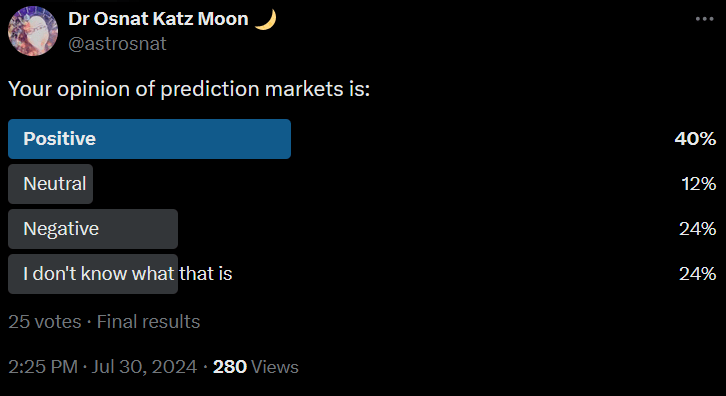
My followers seem to like prediction markets, but I expected that. They’re not a random sample. They’re people who chose to follow me, a prediction market wrangler. (Also, this poll only got 25 votes. My signal-to-noise ratio is not good.)
As a certified prediction market enjoyer, I’ve been thinking about why people might not like prediction markets, and how we might change that. Here are my (very rough) thoughts.
Why might people dislike prediction markets?
The name is kinda goofy
Sorry, it just is. It makes prediction markets sound scary and technical. This is not what you want for widespread uptake.
The fans are weird
Sorry, we just are. To be honest, “weird” might be the least pejorative way to describe us. The alternative is being called tech bros or TESCREALists. Anyway, to people who are not us, we’re oddballs at best, evil at worst.
Gambling is stigmatised
A common theme I see in criticisms of prediction markets is “this is basically gambling, and gambling is bad”.
I think to some extent this is a cultural disconnect – most of the prediction market discourse is US-centric. In contrast, I grew up in the UK, where gambling is not only legal but pretty normal. In fact, through the National Lottery Heritage Fund, state-regulated gambling funds conservation projects across the UK.
I think some of the stigma has a point: gambling can be addictive and it can be destructive. In my view, the way for prediction market institutions to address this is to voluntarily bind themselves by best practices, give users tools to limit their spending and the time they spend using prediction markets, refrain from advertising that promotes gambling as a social activity or a way to get rich quickly, and signpost users to gambling addiction charities.
How can we change this?
Make prediction market software accessible to everyone
Prediction markets would probably seem less scary and technical if we could make them more widely accessible. I’m currently testing out software to let people do just that. It’s called SocialPredict. You can run it yourself on your own machine, or set up your own prediction market website in about 3 hours. Also we have a pre-alpha you can look at called brierfoxforecast.com. My own ridiculously early hack-y instance is called openprediction.xyz. It doesn’t cost money to use and the software will stop you from placing too many trades or making too many bets.
Change the name?
If “prediction market” sounds scary and technical and “gambling” sounds bad, maybe we should call it something else. Maybe “better predictions” or “social forecasting” or something. Names are important.
Commit to being ethical
There’s not really a way to get around this: prediction markets do have an image problem. They’re associated with being scary, technical, weird, and a predatory vice product. I think that building trust with people who are not prediction market enjoyers requires holding ourselves to high ethical standards. Non-exhaustive list of ideas for doing this: being honest, listening and engaging actively, trying not to be predatory, following best practices for mitigating against gambling addiction, etc. I realise that this sounds a bit like bullshit corpo-speak, because there’s not really a script for convincing people you’re sincere and trustworthy. Currently it’s the best I’ve got. I welcome anyone who can do better.
These thoughts are a starting point, not an end point. I don’t have all the answers. I just happen to have some of the questions.
 Osnat Katz Moon